VIDEO: Forging a New Coalition for a Just Climate Transition


Below is a lightly edited transcript of a panel discussion at our second annual Wallace Symposium, which brings movements together to fight fascism and envision a more equitable future.
John Cavanagh: So this panel is on forging a new coalition for a just climate transition. We’re really thrilled to have the three people sitting up here. I’ll say a word of introduction about each of them in a minute. Saket Soni gave a transition to this panel as he talked about new ways of responding to climate disasters. But here we want to shift a little bit, so a couple words on the big picture we’re dealing with.
Progressives have long known that the big solution to building a future in this country and around the world that can confront the climate crisis but also confront inequality and build strong union jobs for millions of workers is a massive transformation of our economies, from fossil fuels to clean energy, and thousands of movements and unions around the country and around the world have fought to speed up this transition in an equitable and a worker centered way.
This is the big vision: a massive transformation from fossil fuel and war economies to green economies built from the bottom up, with democratically controlled institutions. Some of the ideas that were coming forward in the last panel — addressing not just climate obviously, but climate justice. And powerful movements have kick-started this transformation here and in many other countries, despite the power and influence of big oil, and despite leaders like Donald Trump.
So now, in 2025, the Trump administration has interrupted this transformation. So for four years at the federal level, we will be fighting defense. No progress at the federal level for four years, but California and other states are forging ahead. Communities are forging ahead, youth led movements like Sunrise and the divest from fossil fuels movements are forging ahead.
So we have three wonderful people here who will help open our minds to the best strategies for this moment. So we’re going to start with them, but as with the other one, we’re going to open it up to all of you. So as you think of questions, as you’re hearing them talk, please write them on note cards. There are folks here who have note cards, who have pens, and pass them back, and they’ll make it to me, and I’ll ask your questions.
Okay, who are these three amazing people that are sitting right up here? Some of you know them, but let me just say a word.
Ben Beachy, first, is Senior Fellow at the Global Fund for a New Economy, former Special Assistant to President Biden for climate policy, industrial sector and community investment. Some of you, though, know Ben because he spent two decades advocating for equitable industrial policies at various climate labor and other groups, most recently the Blue Green Alliance. I got to know him at the Sierra Club.
Then, Aru Shiney-Ajay is the executive director of the great Sunrise Movement, which many of you saw splash on to the scene a few years ago, a youth movement to stop the climate crisis and force the government to pass a Green New Deal. Aru has been organizing since 2016 around climate, racial, and economic justice, and eventually led her school’s fossil fuel divestment campaign.
And then finally, Johanna Bozuwa is the executive director at the Climate and Community Institute. Check that out. She directs the network of researchers and experts to develop crucial and justice-based climate policy. And I’ll just say, prior to joining the Climate and Community Project, Johanna managed the Climate and Energy Program at a group that grew out of IPS’s founders, Gar Alperovitz, The Democracy Collaborative, a think tank focused on designing a more democratic economy.
Okay, so we’re going to start with Ben, but I am going to ask the same question of all of you, which is: What opportunities do you see to expand the climate movement while building for what comes next — and are there one or two activities at a state or local level that you think can help keep us moving?
Ben Beachy (4:54): Thanks, good morning. Oh, I’m from West Virginia. When we say good morning, we often have a response.
Audience (5:00): Good morning.
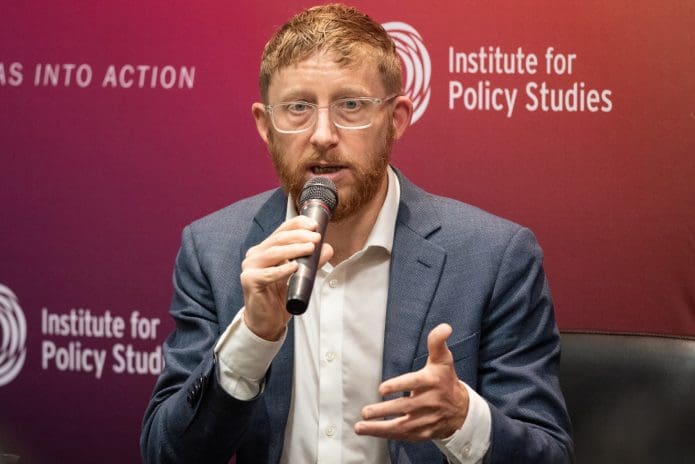
Ben Beachy (5:02): It’s good to be with you all. I first want to just say — really appreciate the opportunity that you all have created to have a big think in this critical moment. You know, we certainly need firefighters at this moment to be trying to extinguish the flames that Donald Trump and congressional Republicans are setting to everything that we have built. We also need architects to be sketching out what we intend to build in the ashes, and it makes sense that we’re having this conversation right now.
It was during the first Trump administration that we, many of us in this room, helped to build the vision, the narrative, the policy framework that eventually led to the Build Back Better agenda, and it is now that we have the opportunity and the necessity to build out a next wave of climate policies, a new climate agenda that can cut costs for families, create good jobs, and revitalize hard hit communities.
But how we do this really matters. I think we have an opportunity to do this a little bit differently. I think we have an opportunity to recognize that local labor and community and environmental groups on the ground are the agents of policy change, not its passive recipients, right? We have the opportunity to merge the building of policy and power.
And I take a lesson here from the Inflation Reduction Act, the largest climate investment in history. You know, we got a lot right with the Inflation Reduction Act, but there’s one premise of that law that has gone unfulfilled, and that is that by linking climate investments with economic benefits, we would spur this really broad-based popular demand for more and more waves of climate investments. There would be this virtuous cycle where climate investments yield economic benefits which yields votes for more climate investments. I think it’s safe to say that has not materialized. We do not see a popular clamor for more climate investments among working people in suburban Atlanta or in southeast Michigan.
I think we have to be real about that and ask why.
There are several reasons. One of them that I would point to is that the process of crafting climate solutions, of crafting climate policies, has thus far not included most working folks, right? I don’t think that most people are going to be calling for another wave of climate investments if they don’t see themselves in those investments. And I don’t think they’re likely to see themselves in those investments if they did not help to build them.
So the path forward is not for D.C. professionals like myself to bust out of our offices in a few years and say, “Guess what? Working America, we have crafted IRA 2.0 and trust us, it’s going to be great for your family and community.” I mean, that would fall flat. The workers and communities who most stand to benefit from a next wave of climate investments need to be at the forefront of building that wave.
I think that is critical to get the policies right, and it’s also critical to build the power to get the policies passed. For too long, we have treated the crafting of policy and the building of power as two separate crafts, right? Those of us who are policy wonks are entrusted to write the policy, but pretty much everyone else is entrusted to provide reliable votes every couple of years, maybe some calls to Congress, but not really policy ideas.
Well, that bifurcation has several problems. One, it’s not particularly democratic. It ignores the lived experience of millions of people. The core tenet of democracy is that those impacted by a policy should have a say in its design. Two, it yields subpar policies. You know, those of us in the D.C. bubble often bring a lot of technical expertise that’s helpful, but we often lack on the ground expertise for how policies are actually going to play out in communities, and that is information that local organizers can readily offer if they’re brought into the process. And three, the inside baseball approach is a proposal to build policy without building power. That’s not exactly a winning strategy. I mean, if we were to try to craft the next big thing for climate in the D.C. bubble alone, I think we’d end up not with a passed law, but a white paper.
And so, we need to merge the building of policy and power. We need participatory policy design. And the good thing here is, as you mentioned, John, we actually have opportunities in the near term, in states and cities across the country, a number of states and cities will be designing and passing clean energy and other climate policies in the next couple of years.
Could we equip unions, community groups, environmental groups on the ground, to be at the forefront of designing that next wave of climate policies? And we don’t need to draw on theory here. We can actually draw on practice, on established models that have worked.
I’ll end with this. In Illinois, during the first Trump administration, there were about 20 odd groups that came together: faith, climate, labor, community groups, gathering in church sanctuaries, in rec centers, to hash out what they wanted to see in a climate bill. They then partnered with state legislators to translate those high level priorities into the technical prose of legislation. And because there was a big tent push to assemble this bill, there was an equally big tent push to get the thing across the finish line over some entrenched interests.
And I don’t think it’s coincidental that that participatory approach led to one of the most ambitious and equitable climate policies that we’ve seen at the state level. And yet, Illinois is the exception. It’s not the rule. It needs to become the rule, if we’re truly going to build a climate agenda by and for workers and communities, an agenda that reflects on the ground priorities and enjoys broad backing — an agenda we can win.
John Cavanagh (10:52): Great. Thank you so much, Ben. Next, same question to you, Aru. It’s fabulous to have you here and thank you for what you do at Sunrise. So what opportunities do you see to expand the climate movement, particularly in your case, among youth? And do you want to highlight one or two state or local activities at that level that are getting us moving?
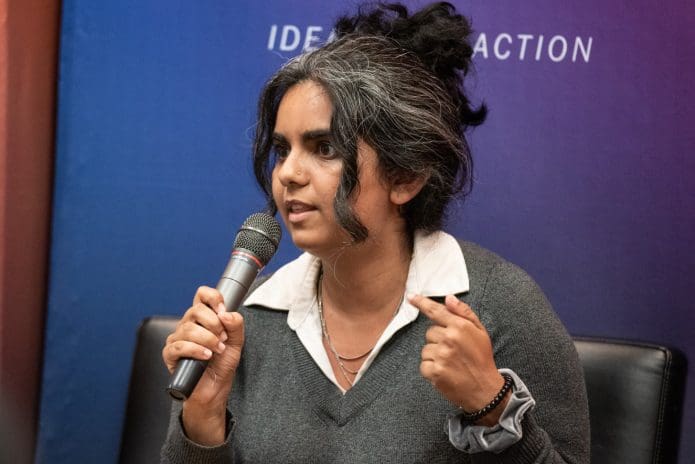
Aru Shiney-Ajay (11:10): Thanks, John. It’s an honor to be here with you all, and I definitely echo a lot of what Ben was talking about. To me, understanding the climate movement in this moment requires understanding what a deeply anti-system moment that we are in as a country right now. I think that’s particularly true of young people.
There was a lot of hand-wringing about the rightward swing of young people in the last election, and from what I saw, knocking on doors, going to college campuses, the overwhelming sentiment was not, “I love Donald Trump.” The overwhelming sentiment was, “this country isn’t working.” We have grown up with false promises of what we can and can’t achieve, and most people my age can’t dream of a normal, middle class lifestyle where you can affordably live in the city that you grew up in, and think about retiring at a normal age, or think about even having kids. This dream has evaporated in front of our eyes.
And so that’s the context of all of this, for me, it’s that this anti-system sentiment is what drove Donald Trump to power — and unless the climate movement is actually able to tap into that and say that what we are doing is not just a continuation of what we have, but a little greener, but is actually an overhaul of the political and economic system that got us here, unless we’re able to tap into that, it’s going to be extremely difficult to meaningfully build the climate movement beyond who has already been in it, beyond who’s already been mobilized.
And that’s what Trump did really effectively as well. And I think that if we look at the the lessons of the last term, of the IRA, to me this is really deeply tied to when Biden was able to come into power and when we were fighting for Build Back Better, there was an inability to be able to push for the structural political reforms that would have allowed us to pass sweeping legislation at the scale needed, forcing us to negotiate through like an arcane reconciliation process.
You know, many people could speak to it in more detail than me, but frankly, it is ridiculous that we live in a system that forces us to address the most urgent problems of our generation through these processes. So that’s that’s a lot of how I think about it — we need to set forward a vision of overhauling our political and economic system and tap into the populist moment that we live in right now.
I think there’s a lot of different campaigns that have the potential to do that. One campaign that we’re running in several states and that we’ve found really, really effective is the Make Polluters Pay campaign, asking for polluters to pay for the effects of climate disasters. We’re running it in many states. I’ve been really enjoying talking to our Florida hubs about this, where they are finding so many doors that they knock and have Republican voters saying, “oh yeah, I support making polluters pay for climate disasters.” Because who wants to pay the bills for the effect of disasters on their own homes?
I think it’s that sense of telling a story that there are villains to blame for this crisis. There are fossil fuel billionaires who have brought us here, and that ordinary people can benefit from the policies that we pass, and that we want to do that not only at a state level, but use that state level policy-making to build the types of bases that are able to eventually build up to the type of mass disruption, mass pressure that we need for larger structural reforms — that’s the path that we need to lay out.
And then I think the other thing, especially for young people, is laying out a credible path to change. You know, many of us were in high school during the mass walkouts for March For Our Lives, and then for the Climate Strikes, and what I see among my generation is not actually a skepticism of the problem or a skepticism of the solution. It’s a disillusionment with whether or not we can win anything in the first place.
I used to run Sunrise’s training program. We used to have to spend much more time being like here’s what the climate crisis is. Here is the scale of overhaul we need in order to win. People are on board with that now. They’re like, “yeah, okay, but how are we going to do it? What is the strategy?” I think that’s the other thing I’d say around the climate movement is that we really need to get a lot better and sharper about articulating credible strategies to win governing power. One that’s not just having a rerun of the last few years — people have seen millions of people mobilizing in the streets, resulting in much smaller wins than we need.
And so we need to be able to say here’s how it’s going to be different. Here’s how we’re actually going to create structural reforms that allow us to pass really, really big legislation. Here’s how we’re going to use direct action and mass non-cooperation to disrupt economic systems enough that we have forced structural concessions. That type of organizing vision, alongside the policy vision, is really essential to being able to actually mobilize young people in this moment.
John Cavanagh (16:28): Thank you. Okay, on to you, Johanna. The same question.
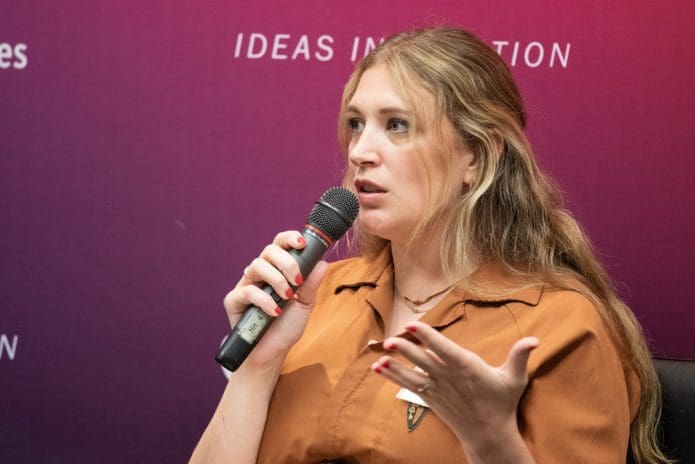
Johanna Bozuwa (16:33): Yeah, thank you. Wow, going after Ben and Aru is a hard thing to follow, but also so great, because the amount of alignment that’s already on this panel is so clear to me. So I’m probably going to hit some of the things that Ben and Aru have already talked about, but the way I wanted to open actually, is about an experience my colleague had, when she was off of her job in New York City on primary day.
It was 105 degrees, and she was going around to the different polls to see how things were going. And it was often in these schools in Queens or in Brooklyn, where poll workers were in the basement of these schools with no AC, just about fainting — they didn’t have water on hand. And these are largely black women workers who are really in this moment at the front lines of our democracy and climate change. So she had to call the election board to say, hey guys, these people need water. These people need AC. Can you bring fans in? And they sent paper fans. This is what our democracy looks like on climate change right now.
And in this moment it was a primary in which we had a very institutional actor who was on the ticket, and someone who was a progressive populist candidate as well: Zohran Mamdani. And Mamdani crushed in that primary in a way that we hadn’t…I feel like the left was feeling a little sad and this was this incredible moment of saying oh my goodness, things are actually possible.
And the reason he was able to get that message across and have such a wide swath of young people, bodega workers, teachers that really crowded in behind him was because he was talking about a vision of what an affordable New York City looked like. He told you, “yeah, the landlords have made your rent too damn high, and we actually can do something about it.” And he connected affordability to the future that people actually want to live in.
And this campaign may not be coded as a climate campaign, but in many ways, it actually is. The biggest thing is that, if you hear someone from the Mamdani campaign talk, they say we’re going to give you fast and free buses. That is so obviously also a climate campaign that’s about actually giving people access to transit, allowing their lives to get better, and also maybe electrifying those buses along the way.
And so, you know, I think that this is the type of campaign that’s emblematic of where we should be going and how we should be thinking about integrating climate into the type of power building that is necessary — being able to connect the cost of living crisis we’re currently in to the climate crisis and actually saying we have a solution for you. And I think that that is actually what could create fractures and fissures in what we’ve seen, as Aru very clearly pointed out, a working class base, a young base, that’s an increasingly multiracial base that’s shifting to the right because of the sheer feeling that this system isn’t working for us.
And so we have to say, “yeah, we totally agree with you.” And instead of the political coalition that Trump has been able to make — of this multiracial working class that is working alongside billionaires and pointing at our institutions, our government, as the problem — we need to actually redirect that conversation and say “no, no, like we hear you absolutely, this is unacceptable, and it’s actually it’s the elite, it’s the fossil fuel companies, it’s CEOs, it’s the healthcare CEOs, it’s Jeff Bezos that are the problem, and we actually have a solution.”
At the Climate and Community Institute, we think about how we actually work alongside the working class to integrate climate into their fights. So one of our core partners is the Tenant Union Federation (TUF), an incredible group that’s combined a lot of tenant unions across the United States that are actually fighting for affordable rent and their living conditions. And these are the people who are trying to survive through not having AC in their house when it’s 105 degrees. And by working alongside them, it’s actually an opportunity for us to say “yes, oh my gosh, you are experiencing a climate crisis right now, and we actually can build an alternative. We can instate rent control, and we can, on the longer term, fight for things like green social housing or green affordable housing.”
And so I think it’s about also providing people with clear material benefits early on and building alongside them. So it’s not a climate movement. It is a working class, broad based movement and climate is one of those pieces. Because, as we know when it comes to the cost of living crisis, climate is, in fact, the multiplier of the cost of living crisis, and it can also be a part of the solution.
John Cavanagh (22:11): Fabulous. Thank you. You’ve opened up a lot of things here. I did want to just throw one more thing into the debate that none of you mentioned, which is one of the central campaigns of the climate movement over the past decade that the Wallace Global Fund also played a key role in, is the campaign to get institutions to divest from fossil fuels — be they governments or union pensions or, in the case of Ellen Dorsey at Wallace Global Fund leading that effort with Scott Wallace and Scott Fitzmorris, in the foundation world.
I’m curious, as you said, Aru, you said people want to know who the enemies are. And that does lift up the enemies, the top fossil fuel companies. We’ve also, at IPS, helped with a website, climatecriminals.org, which is more focused on individuals.
An observation: I don’t think most of us could name one of the people who you all would think of as a top climate criminal. So I’m curious what you think the next phase in the divestment movement is. It’s interesting, after lunch we’ll turn to foreign policy, where, of course, student groups have been focused both on divesting from fossil fuels, but also divesting from weapons manufacturers whose arms go to Israel.
What would you say to students about those fights? Or do you think we should also pull leading individuals? Who is the Elon Musk or the Jeff Bezos of climate criminals? Don’t know which of you would like to start with that.
Aru Shiney-Ajay (24:04): I can start us off. Yeah, I entered the climate movement through my college divestment campaign, and the thing I remember being drilled in was that our goal is to revoke the social license of the fossil fuel industry, and being told that over and over, it was not about just what we win or what we lose, or like what our administration tries to negotiate with us. It’s like, can we make everyone on this campus hate the fossil fuel industry, not want to work for them, not want to touch them?
And there was this report that came out from the American Petroleum Institute while we were running our campaign that was freaking out about the divestment movement because they were saying that they were no longer getting job applications from any of the top universities. And that was the reason they were freaking out more than anything else, which I think is really interesting in tracking what is the power that we actually have to make the industry scared.
It is about revoking the social license. It is about young people not wanting to touch them with a ten foot pole. So to me, when I think about the future of the divestment movement, that’s what I think about. It’s like, how can we actually villainize these people and these industries to the degree that we need to?
And I think that that can be done in many ways. I think the climate criminal stuff is really interesting. I think there’s a lot of hunger for actually being able to point to the villains. A tactic some people have been tossing around in Sunrise is going to the yards of fossil fuel executives and actually digging them up and planting graves in them, being like, you are responsible for the mass deaths that we are seeing in this moment — just like actually thinking about how to lay the blame of this crisis, of these basically climate murders, at their feet. So I think there’s a lot of tactics that we could do.
I think the divestment movement, in particular, could benefit a lot from thinking about what it means to tell a story of what we can build alongside pointing out the villains. So I think there’s been a lot of movement towards divestment and reinvestment in moments. I also know a lot of campuses are thinking about, like you said, divestment from fossil fuels and weapons manufacturing hand in hand, which goes right along with what it means for university campuses to stand up to the Trump administration right now. I
f you look at the top corporate donors to the Trump administration, you basically see Lockheed Martin, Exxon. I’m not remembering the next three, but they’re basically all climate and military donations. So that’s a little bit of what I see. And I think there’s a lot of momentum in the student movement going in that direction.
John Cavanagh (26:38): Others of you. Johanna?
Johanna Bozuwa (26:40): I can jump in. Aru, I think that’s so clear. I was just at another meeting where there were a lot of frontline folks from Texas and Pennsylvania, these places, where they were just describing the amount that the oil and gas industry has been able to integrate themselves into the culture of the place: giving things to little leagues, creating green spaces to allow the continued extraction right next door.
I think there’s another problem with this, obviously, it’s that the public isn’t providing public infrastructure. We aren’t actually providing to allow people to have leisure space and green space. And instead, people feel that they can’t lose the oil and gas industry in their community, because then they lose their little league team, they lose their football team, they lose the stadium that was like their place of convening.
And to Aru’s point, being able to erode the fossil fuel industry’s power over people, and lay that mass death at their feet, and also be able to say, we can build a public. We can actually create pools in your backyard. We can figure out how to finance that and like, give people something that is concrete in their backyard that they’re going to be able to see in a way that…it might not be that it’s solar right off the bat, right, but it’s a pool that they can cool off in in the heat of the summer that now is hotter and hotter in Texas.
And that allows us to get to a little bit of that virtuous cycle that was part of the theory of change with the Green New Deal, and Build Back Better, and we can figure out how to do that at that more localized level, so people can also see it physically.
Ben Beachy (28:38): Throughout the last couple of decades, the corollary to divest has been the invest side, right? And so maybe the thing I could add is on that side of the equation, because I think the invest side also directly allows us to address people’s actual lived economic anxiety.
You know, as you mentioned, Johanna, like free buses, green social housing, et cetera. We have an opportunity to address people’s daily realities on the invest side. And this is actually one thing that I think we did get right with the Inflation Reduction Act. And you know, the core premise that I think has borne out was that we can actually deliver on climate and jobs and justice goals at the same time.
We all know that to tackle the climate crisis, we’re going to need to invest in pretty much every sector of our economy in order to force transformation. And if you’re investing billions of dollars across the economy, you’re going to be creating a lot of jobs, and that creates an opportunity to not just create any jobs, but high-paying union jobs that offer a road to the middle class, if you use high road labor standards. And that’s why in the IRA we had a lot of labor incentives attached to all the money going out the door, encouraging clean energy companies to partner with unions on project labor agreements, to pay decent wages, to use registered apprenticeship programs, etc.
And if you’re stimulating all this job creation and growth of strategic industries, well that creates an opportunity to redress longstanding economic injustices by ensuring that a large portion of those investments are going to the communities that have been really hard hit. You know, you see it in the IRA incentives to invest in low-income communities, coal communities that have powered our nation for generations, communities of color fighting for clean air and environmental justice.
These are communities that have been at the back of the line for federal investments for literally my entire life. And the proposal of the IRA is, can we put them at the front of the line? Climate, jobs, justice — that trifecta really was the heart of the strategy we were trying to pursue with the IRA.
Now I just want to say there are some naysayers to this approach. Recently, we’ve heard some people who said we’re trying to do too much here. We are guilty of an “everything bagel strategy.” And by that they mean, if you really are serious about climate, you should just dispense with all this jobs and justice stuff. It kind of gets in the way.
I don’t know if any of you have had an everything bagel. Here’s the thing about them. They taste good. And they taste good for a reason. They combine ingredients that go well together — garlic, onion, sesame seeds.. not unlike climate, jobs, and justice. I’m serious here, right? We all know that to tackle the climate crisis, we’re going to have to mobilize trillions of dollars in climate investments. Properly guided that wave of investments can flow into good union jobs. Properly guided, it can flow into communities that have endured decades of divestment. Properly guided, our climate strategy is a job strategy is an equity strategy.
And at this point, this is not just theory, it is practice. While Republicans just voted to rescind large portions of the IRA, we do have data on the first couple of years of the law, and it shows that we’ve got a 100 gigawatt boom in clean energy in this country, clean energy installations, the highest ever on record. We have the highest ever union density in the clean energy sector, creating an opportunity for good jobs. And three quarters of the investments are going to low income communities.
Climate, jobs, justice. That is not an accidental outcome. That is a deliberate result of the everything bagel strategy that we are pursuing, and one that I think we should build on for the next wave. I think as we move forward, we need to not ditch this bagel, but use it, because it’s a bagel that is feeding workers, communities, and clean energy alike.
John Cavanagh (32:43): Wonderful. Okay, we’re going to weave in now some questions that are coming up. So keep them coming.
One of them has to do with Scott Wallace. He urged everybody, especially the younger people in this room, to run for public office. The question is, can you tell us about candidates that you feel have integrated a climate agenda that is broad in the way you’ve all talked about it and that you’re excited about? Is there anyone running in 2028 that you could imagine that would embrace this agenda?
But I’d also like to expand that a little bit: what would you have them run on? And it was beautiful, Aru, you just pointed out that Mamdani ran on — one of his top three things was free buses. He was linking it all together under affordability. So I’m curious, what, in addition to free buses, would you urge people to be running on that has climate at the center, but [also] deals with justice and jobs and so on? Concretely, are there another couple in addition to free buses?
Aru Shiney-Ajay (34:10): My favorite that I would love to see people running on is a federal jobs guarantee. I think it’s one of the best ways to actually talk about the sheer scale of work that is needed to transform this country. I think it taps into a lot of the rising economic anxieties we’re seeing, and I think it’s going to extra tap into it, given the rise of AI and how many people that we’re about to see face mass unemployment —unlike what we have seen in this country for, like, many, many years.
And to Ben’s point, I think it’s about painting a vision of jobs that can actually give you a pathway to the middle class while actually doing something constructive and productive in your community. And I see that longing in young people all the time. So many people actually just want to do something that pays well and is meaningful in the world.
And I think that could be like, a really winning piece of the agenda in 2028. So that’s, that’s my first take, but I’m curious to hear from y’all.
Johanna Bozuwa (35:11): I also love a federal jobs guarantee. A few things that I think I would put on the agenda for someone who’s running is schools as another place, because I like to call schools the charismatic megafauna of, like public infrastructure. It’s like, where everyone goes.
You have to drop your kid off at school. That’s where, as I was talking about at the beginning, you go to vote. It’s where teachers work, and I think it really is this hub of community in a moment in the United States where we actually don’t have as many hubs for community as we deserve. And we’ve also seen the teachers movement, the teachers unions, absolutely kick butt and really fight for things that are not only for them and their wages and their working conditions, but also for their students, for their community.
When we’ve been working with the Chicago Teachers Union, I know Aru and the Sunrise Movement was also involved there, they were thinking about: “how do we get transit to our schools so our kids can arrive here? How do we think about affordable housing?” So it’s this little spot where you’re able to blow out so many other opportunities. When teachers are able to talk about clean energy going on the top of their buildings, or energy efficiency, they actually can say this is going to bring the bills down while they’re fighting also for the bill to go up in terms of their pay going up. So I think this is an incredible type of investment that we can make in people, in students, in communities.
The other piece is housing. Green social housing. Everyone says the rent is too damn high. That is what everyone is experiencing right now. And there are ways for us to already start doing parts of that agenda. Like, why can we not mass procure small induction stoves to go in apartments and actually be able to provide that for people while we’re fighting for something that is even bigger, like green social housing?
So I think those are two kind of core pieces that anyone who’s running in this moment could actually be able to bring a popular base in and bring them into our vision of what the future could look like.
Ben Beachy (37:39): Affordability, affordability, affordability, that’s what I would have folks run on.
And let me just go back to say that we were a little bit hamstrung during the Build Back Better push on this question. It was a record low unemployment, high inflation environment, and our primary economic message to push for climate investments was jobs, jobs, jobs. You can see why that might not have resonated with everyone, because it wasn’t addressing one of the biggest economic concerns of most people at that point, which was that the rent is too damn high, the high cost of living.
But that wasn’t just a messaging gap — that really was predicated on a policy gap.
The number one cost for most American families is housing, of course. We had a bunch of housing investments in the initial Build Back Better agenda. These were green housing investments, pro-climate, pro-worker, housing investments. They were stripped out before the bill was passed. So we couldn’t talk about that. The number two cost of living expense for many American families: transportation. We had a bunch of public transit investments. Some of us in the room fought very hard for those investments. They were stripped out, not all of them, but many of them were stripped out of the final Build Back Better agenda. So we couldn’t really run on or talk about those.
A third cost for many American families: care, child care, elder care. The entire care agenda was stripped out, despite the work of many people across the country. So we were left without a strong policy leg to stand on, in saying this is actually going to meaningfully lower your costs. We have an opportunity going forward to fill that gap, to actually build a climate agenda that cuts costs while, yes, also creating good jobs with benefits flowing to the hardest hit communities.
And just like to double down on the housing point this, we don’t have to dwell on theory. A lot of cities are doing this right now. A lot of cities are pursuing and passing affordable housing policies that create good jobs because they’re union-built houses. They cut your costs because they not only provide additional affordable housing, but they cut your utility bills because they are efficient and electrified houses. They cut your home insurance rates because they’re also climate resilient houses.
So it does have climate and affordability and jobs and justice all built into it, and we have an opportunity now to scale that up to a national agenda for our next governing moment.
John Cavanagh (40:09): Beautiful. Also, thank you for all the terrific questions that are coming up here. We have only about ten minutes left, so I’m going to read a few of them and then focus on one that it would be great for you to to deal with. The first one is: I’m from out of town. Where can I get a great everything bagel in DC? That’s one, not necessarily for you, Ben, it could be for anyone. How can we end all direct and indirect tax breaks and subsidies to the fossil fuel industries? Could we not get some conservative Republicans on board with that, since they’re not for government subsidies?
Then I want to just pull you in on two that focus on divisions within the Democratic Party, if you will. One is we’ve seen the DNC and politicians like Congressman Jeffries refuse to endorse Mamdani. How to make them understand that this is a great agenda, at least in big cities?
And likewise, there’s a debate that I’m not sure everyone here has been part of, but that is a fascinating one in the Democratic Party. In recent months, we’ve heard a lot about abundance as a potential, forward-looking agenda. Some people are putting it forward as an agenda for Democrats. Do you see abundance as the path to climate action?
Feel free if there’s any of those that particularly grabs you. I know you’ve all thought about this abundance debate, and I think that could be helpful for all of us. We can go right down.
Ben Beachy (42:08): All right, so I’m going to take the bait on abundance. There’s so many abundance events — I’m doing another abundance event this evening. All right, so look, I think more ink has been spilled on that word “abundance” in the last few months than really at any point since the word was created — I looked it up — in the middle ages.
I think let’s start with a goal that abundance proponents put out there, which is, let’s build things faster. I agree with that goal. Kind of incontrovertible, right? It’s mission critical that we build things quickly. I mean, from a climate perspective, no climate advocate worth their salt would suggest that we don’t need to build a lot of clean energy and quickly. Not a new idea.
Where I get off the boat is on some of the recommendations for how we’re supposed to pursue that. But again, the goal is critical. A critical goal demands an actionable solution. And to date, a lot of the narrative that we’ve heard from abundance proponents is that it’s high-level narrative, not really policy specifics. Now a lot of that narrative is the problem is just all these regulations, often from overzealous Democrats. These are a lot of labor and equity and environmental standards that maybe were well intentioned, but basically get in the way of building things, and the answer is to roll them back. That’s at least from some abundance proponents.
Well, my problem with that is basically data. If you zoom in and actually look at what’s causing delays in clean energy, you find that the problem is not an excess of policy, but an absence. I mean, you don’t have to take my word for it. You can look at what clean energy developers themselves have said. They rank in order their biggest delays, the biggest causes of delay for their projects. The everything bagel doesn’t make the list. Labor and equity incentives don’t make the list. In four out of five of the biggest sources of clean energy delay, the problem is an absence of policy, not an excess. And so an agenda that would actually truly deliver more clean energy abundance is more policy, not less.
I’ll just give you one example. One of the biggest sources of delay for clean energy projects is community opposition. Well, we have a solution for that. It’s called the community benefits agreement. If you’re not familiar, these are legally binding agreements that local labor and community groups can negotiate with clean energy companies, so as to translate clean energy growth into locally-defined economic, health, and environmental benefits. And we’ve seen a number of these crop up around the country.
In the clean energy sector, you have companies committing to use equitable hiring practices to provide good jobs for underrepresented workers, to provide training pathways to the middle class, to contribute to a local economic development fund. And so essentially, these are opportunities for workers and communities to call the shots over what the clean economy looks like in their own neighborhood. But they also offer something to the clean energy developers, namely explicit support from local community and labor groups for a project to go forward. They offer a path to smooth project completion, instead of risking that a project is going to be opposed and thus delayed or canceled down the road.
And it is because these agreements are supportive of clean energy growth and workers and communities that we incentivized them in the IRA — we included policies to encourage more community benefits agreements as part of the everything bagel strategy. And so the answer going forward for actual clean energy abundance is more of such policies, not less.
And I think we have to get this straight, because the narrative that we have heard from some abundance proponents is basically broad based deregulation, right? And to make a fine point on this, you had Elon Musk a couple of months ago retweeting some abundance arguments to say, “yeah, this is why we need DOGE.”
Aru Shiney-Ajay (47:02): I have very little to add about abundance in what Ben said, maybe because I read his article on it, and if you want to hear more about it, read that too. I think the only thing I’d add about that is that there is something to telling a story of a government that can get things done.
I think that was one of the most dramatically appealing things about Mamdani’s campaign, I think it’s why people were briefly drawn to Elon Musk’s DOGE stuff. And I think that is the bit of abundance that we do need to hold on to: talking about a government that can do things and get it done.
The push towards deregulation is, frankly, a ridiculous takeaway if you look at the last 40-50 years of policy and the results of deregulation on our ability to get things done. I maybe will take one of the other questions floating about, what it’s actually going to take to push the Democratic Party in the direction that we’re seeing.
I think that one of the lessons that I’ve taken from last year is I do actually believe the Democratic Party will align when they see that they will lose their power if they don’t. And I think that it’s as simple as that, when I think about the answer, and what we pulled off with Mamdani, we need to be able to pull that off over and over again enough to scare the people in power, enough to be like, “oh, I actually have no other choice.”
And I think there are a lot of very interesting strategies: state organizing groups looking at how to take over their states, taking over their state DNCs, and their state parties. I think there’s a lot of internal party organizing that’s happening, but none of it is going to work unless there is actually a mass movement and mass organizations that are able to provide the organizing power.
And I think a lot of the lessons from Mamdani’s campaign have been about, “oh, what’s he saying? What are his social media videos saying?” To me, a huge lesson is just the fact that he had a volunteer base that he built that was able to knock on thousands upon thousands of doors. And fill 50,000 volunteer shifts? Yeah, 50,000 volunteer shifts. If you look at the scale of that, that out-does the 2.2 million Obama 2008 volunteers by ratio, it’s incredible. And that type of mass organizing power I think will actually force Democrats on the defensive and be able to force the Democratic Party to align with us.
Johanna Bozuwa (49:35): Yeah, I agree. And, you know, the vibes have to be right? The truth is, a lot of people are voting on vibes. And the abundance agenda — people don’t really know what that means, but when Zohran’s like, I’m gonna give you a fast and free bus, I’m going to cut your rent — that’s the vibe I want to be with. That’s an exciting thing to be a part of. And so like what you’re saying Aru, we have to create the gravitational force, and we have time in this moment to be able, as Ben was saying at the very beginning, to show that at the local and state level, and be able to draw that power forward to the national level.
But I also can’t help myself when it comes to talking about abundance, just a little bit. Ben’s covered it so eloquently, but I think one thing I wanted to add to your analogy around the everything bagel is also the political coalition it takes for us to get things done. We want labor, we want jobs, we want justice, we want climate. But we also can’t win that legislation or that law, unless we have labor on board, unless we have the working class on board, because truly, when it comes to us, we don’t have the same billionaire backing as the right wing. So that means we have to rely on people, and that is the political coalition that’s going to allow us to get over the line. So it’s not only just good for us on a moral standpoint, it is like a political necessity for us to be thinking in that way.
And a piece about the abundance debate that I think is so fascinating — Aru, I think you mentioned this, or maybe Ben — is that it’s this idea of the government doing work or moving quickly. If I think about what the Green New Deal was about, it was about moving really freaking fast, and the government working for you. And they kind of took it, and they were like, “Oh yeah, but let’s do it 90s style neoliberalism.” That sounds honestly awful.
This person I was talking to the other day described abundance as like, “what if it’s like eliminating the seat belt law, and we’re in cars?” Cars are the most scary things out there. They kill more people in a year than basically anything else. And it’s eliminating the seat belt law. So the idea is like, “well, if we eliminate the seat belt law, then at least we’ll get a bunch of clean energy on the grid.”
For me, yeah, that’s a really big risk, because guess what the vehicle crash is? It’s the fossil fuel industry who, when we strip those laws away, they can run in and they’re actually better at being able to manipulate these systems. I want to actually tackle the climate crisis, which means that, as Ben says, we actually need to build the policies that are going to allow us to do that. And for me, the thing that feels like the right type of seatbelt law is actually investing in our federal government, investing in a bureaucracy.
And the reason it often hasn’t worked is because we have an anemic state that has been just whittled down for decades. And the truth is now we’re in a moment in which the state has been absolutely decimated. And if we’re going to be the phoenix from the ashes, that gives us a huge opportunity to rebuild and actually bring people in. There are so many people in the Federal Unionists Network that are actually thinking things like we know our previous jobs, we know we can do it better. And they’re waiting in the wings, and that’s a huge opportunity for us.
John Cavanagh (53:36): Okay, great. We have just three or four minutes left, so you each get one minute on this, but I’m curious if there’s anything any of you would want to add to that final point that Johanna made, that the movement in this country with the most power right now is the organized labor movement. It also has great public support. The majority of people, overwhelmingly, say they want unions.
So any other thoughts on how to build that even more powerful coalition that has labor at the center of climate solutions? I know you’ve all dedicated your life to these coalitions, but anything you’d want to add on that.
Johanna Bozuwa (54:24): I think you’ve said a lot, even in your question, right? The labor movement has been ascendant, seeing the UAW, seeing the teachers, there’s so much energy there, and I think there’s so much opportunity in every workplace environment to connect to these issues of climate.
I was just talking to someone from the Labor Network for Sustainability who was talking to a Waffle House worker, and she was like, “it’s actually kind of wacky that we’re the front lines, like we have to go in until…” I don’t know if you all know this, but it’s like the Waffle House weather thing, where they’re always going to be the last ones open. And so they’re talking about their experience of how that makes them a frontline climate worker. That’s wacky. That’s totally wild.
And so I think if we’re able to find that even when you’re talking to a Waffle House worker, it’s not only clean energy workers who are actually experiencing the climate crisis. She was also mentioning someone who works in Hollywood and is a cameraman, and he was talking about how AI is running in the background and all these machines are making it so much hotter on set. And it’s already hotter on set, because they live in California. There are all these different things that actually mean that so many different facets of labor are experiencing the climate crisis, and it gives us such an opportunity to be able to build with them.
(Also, because I know we’re closing out, I have to say that I no longer live in D.C., so I don’t have a favorite bagel place. But I do live in Maine, and if you want a good bagel place in Maine, it’s Rose Foods in Portland.)
Aru Shiney-Ajay (56:11): Yeah. I mean, I definitely think that there’s a huge necessity to build a climate movement with labor at its center. I think that actually includes a lot of young people who are not necessarily in unionized workplaces, but who are interested in unionizing their workplaces. And thinking about the enormous potential that exists in the next few years for that is one of the things that makes me really excited.
I’ve also just been amazed by how many young people are following the UAW’s calls, for example, to align contracts in 2028 for a strike. That call has received more organic momentum and has given people, I think, a lot of hope, something to hang their hats on. So that’s certainly something that I’m tracking.
And then, you know, we’ve all said this throughout the panel, but obviously whatever policy, whatever vision you are putting forward for what the climate movement needs to look like, it absolutely needs to have labor-centric demands if we are to have any hope of actually building a movement across that. So that’s a key part of it as well.
Ben Beachy (57:16): Yeah, I think the thing I would just say, echoing some of the sentiments already, is that organized labor unions are not some ancillary partner to the climate movement. They are its agents, right? Alongside community groups who are impacted on the ground.
And by that, I mean that, going back to abundance — you know, who likes building things? Organized labor. They are our core partner. And without the perspective of unions on the ground, I don’t think we’re going to build the right policies. This goes back to the first question I was addressing. We will get the policies wrong if unions are not part and parcel of the design of those policies. Because the people who are actually going to be building the houses, the green social housing, the people who are going to be actually installing clean energy, the people who will be manufacturing all the widgets for the clean economy, they are workers increasingly represented by organized labor. And it’s not just that they provide good jobs, it’s that they represent that intelligence base of workers on the ground who are on the front lines of building the new economy that we need.
And the other point, just to echo Johanna, is that the notion that we should exclude labor is going back to something I said earlier, it’s a proposal to build policy without building power. Like this notion, and this is not all abundance proponents — some abundance proponents would not say this, but we have seen some commentary. “You know, the problem is the groups, we should just take the groups out.” And by that, they mean unions, and also environmental groups, and all these community groups. We should really go back to just, I don’t know, inside baseball.
Well, that is a proposal to cut out all of the forces that you need to actually win passage of policy. That is a plain bagel strategy, and no one likes a plain bagel.
John Cavanagh (59:13): Please join me in thanking our panelists.